Wednesday, September 10, 2008

Quote of the Day

"Christologie wird bei Küng wieder neu, was sie ursprünglich einmal war: eine Suchbewegung unter der Leitfrage: Wer ist dieser? Welchen Gott verkündet er?"

Karl-Josef Kuschel in his essay "Hans Küng: Neue Horizonte des Denkens" in Hans Küng – eine Nahaufnahme, p. 57. With an impressive list of contributors and at only 10 euro, this book is what German's would call a definite schnäppchen.

Labels:

My thanks to Hans Küng

For kindly sending me a copy of the new book: Hans Küng – eine Nahaufnahme. A nice touch is that it arrived in the post on my last full day in Germany, and that in the front Küng wishes Anja and I all the best for, as he puts it, 'Merry Old England'!

I haven't gotten too far into the book yet, but Karl-Josef Kuschel's chapter, "Hans Küng: Neue Horizonte des Denkens", is simply brilliant – a must read for anyone interested in Küng's work.

Labels:

Friday, December 15, 2006

Küng and Hengel

What a busy last few days! However, a delightful gift came in the post a couple of days ago from none other than the great theologian, Hans Küng! One of the items in the package was a signed copy of the Lew Kopelew Prize ‘order of ceremony’, including speeches (mentioned here). What a lovely surprise!

As I read the speech it became clear that the translation we offered a few days ago on this blog was faulty. Rather than stating that Americans have been misguided ‘by a President arrogantly presenting himself as a Christian’, the German actually says: ‘daß sie von einem arroganten, sich “christlich” präsentierenden Präsidenten ...’ which is, if anything, an even stronger formulation!

Yesterday I was pleased to take part in the 80th birthday celebrations of the great NT scholar, Martin Hengel, in the Tübingen Theologicum. I made a couple of short videos (but as shall become abundantly clear – I will upload them later –, I’m really not film director material!) and managed to get a picture of the back of David deSilva’s head (I’m not paparazzi material either)! The wonderfully friendly, and massively learned, William Horbury gave the honorary lecture in pretty convincing German. Given that I deal with and take issue with Horbury’s thesis concerning early Christology in my doctoral work, it was a delight to hear direct from the ‘horses mouth’, even if I’m still profoundly unconvinced. I’ll blog more about the celebrations later.

By the way, for those who have e-mailed me in the last few days, thank you. I will reply as soon as possible.

Labels:

Thursday, December 07, 2006

Hans Küng receives the Lew Kopelew Prize!

I’m happy to inform the biblioblogging community that Tübingen based Theologian, Hans Küng, received the Lew Kopelew Prize for Peace and Human Rights last Sunday, for his ‘unermüdlichen Einsatz um ein besseres Verständnis zwischen den grossen Religionen der Welt’. It was a real joy to watch the whole presentation on TV. As to his speech, I was both surprised and pleased how bold and forthright he was in his criticisms of the Bush administration. For example, in the context of peace among the world religions, he courageously claimed that he:
‘considers it a positive development, at least since the loss of the congress elections in Nov 2006, and the long over due outing of the incompetent and warmongering defence minister, that most of the American citizens are slowly coming to realise – one has to say this clearly – that they have been misguided, yes misguided, by a President arrogantly presenting himself as a Christian, by a neo-conservative ideologist, and by a passive congress as well as willing mass media’ (translation ours).
Earlier he spoke that (our translation shortens the original German considerably):
‘Instead of effectively fighting a criminal network, this president thought he had to announce a war, marching into Afghanistan and, despite his father’s wisdom, into Baghdad, thereby turning his father’s idea of “the new world order” into a “new world disorder”!
Küng has never been one to duck a fight, at least one in the service of peace and human rights!

By the way, I hope the person from New Jersey, United States, found what he or she was looking for when their Google search for ‘The Biblical Significance of a Sneeze’ landed on my blog! Why oh why would anybody want to search Google for that?!

Labels:

Saturday, October 14, 2006

Theologe Küng

Küng says Pope doesn’t know enough about Islam (hardly breaking news, but, hey)

Labels:

Sunday, July 23, 2006

Final post in the Küng 'Der Anfang' series

This series has taken about 7 months, so it is good to finally post my last.

Following is a section outline of the book, followed by links to the relevant posts. I hope you enjoyed reading the posts as much as I had writing them.

What did you think of the book? Any general comments?

Introduction
Part 1

A. A unified Theory for everything?
Part 1, part 2

B. God as the beginning?
Part 1, part 2, part 3, part 4

C. World creation or evolution?
Part 1, part 2, part 3

D. Life in the cosmos?
Part 1, part 2, part 3, part 4, part 5, part 6, part 7, part 8, part 9, part 10
(plus a three post response to Küng and miracles in Der Anfang: here, here, and here)

E. The beginning of the human race
Part 1, part 2, part 3, part 4

Epilog: The end of all things
Part 1, part 2

My concluding remarks. Part 1, part 2, and finally, part 3 (i.e. this post)

Labels: ,

Wednesday, July 19, 2006

Concluding remarks on Küng's Der Anfang

Concluding remarks on Der Anfang Aller Dinge Pt 1 of 3

Now I’ve reached the end of my review of Küng’s book (and thank you for all who have read my posts and made many thought-provoking and helpful comments), I have just a few posts to put on the blog that will summarise some of my thoughts, and look back on the whole series.

The skeleton upon which the meat of the whole book hung can be summarised as follows:
Küng’s reliance on Kantian epistemology, the biblical narratives, existentialism, and an interreligious ecumenism, all surfaced at numerous points, and came to explicit expression in his repeated attempts to encourage epistemological humility from both those in the scientific as well as in the theological communities, while at the same time pointing towards a free and existential trust in an Urgrund. However, especially in relation to his eschatological arguments, the theology of God as Spirit, and his discussion concerning miracles, the influence of Hegel and his correlationist tendencies were also felt. This was all married to a strong, yet not uncritical, confidence in the proposals of modern science, and out of this dynamic his arguments found their form.

Some of the critical matters will be overviewed in the next post in this series.

Labels: ,

Sunday, July 16, 2006

Approaching the end of this 7 month review of Küng's Der Anfang aller Dinge!

We are fast approaching my final post on Küng's Der Anfang aller Dinge. There shall follow a couple of posts in summary of the whole thing, but this posts ends the commentary on the text as such.

Review of Hans Küng’s, Der Anfang aller Dinge, Epilogue, Pt. 2 of 2.

In short, Küng answers this question (cf. the end of part 1 of my review of Küng's Epilogue) in the negative. The end-time stories in the bible are not chronological revelations, satisfying our curiosity with mere information concerning the last days, and to read the bible in such a way is to misunderstand it. Rather:

‘The haunting visions of the Apocalypse are an urgent warning to humanity, and individual humans, to recognise the seriousness of the situation ... The bible doesn’t, therefore, speak in the language of scientific facts, but in a metaphorical picture language’ (223).

And this language, with its actual meaning, is to be translated into the horizon of modern people, and not to be taken literally. And what is the actual meaning? These pictures stand for the hopped for and feared, and particularly represent a faith confession about the completion of the work of God in his creation. ‘Therefore, theologians have no motivation to prefer one or the other of the scientific world-models over the other, though truly they have an interest to portray God as Origin and Perfecter of the world, understandable to humans’ (224). For if God exists and one accepts this, not in light of certain ‘proofs’ but in enlightened trust, then God is surely not only God for here and now, but also at the very end.

Ending on a personal note, Küng writes: ‘Personally, I have accepted Blaise Pascal’s bet, and set myself on – not on the grounds of probability calculations or mathematical logic, but on the basis of a reasonable trust – God and the Endless, over against nil and nothing’ (225). Though Küng doesn’t believe in what he dismisses as the later legendary NT resurrection stories, he accepts their original core, that Jesus didn’t die into nothing, but into God. So die we, into God. And even if Küng’s Pascalian ‘bet’ proves to have failed, ‘I didn’t loose anything in my life. No, I lived a better, happier and more meaningful life than if I had lived with no hope’ (225).

The end of all things, then, is the hope to ultimately die into the light: ‘And there will be no more night; they need no light of lamp or sun, for the Lord God will be their light, and they will reign forever and ever’ (Rev 22:5)

Labels: ,

Saturday, July 15, 2006

Küng on the end of all things

Review of Hans Küng’s, Der Anfang aller Dinge, Epilogue, Pt. 1 of 2.

Epilogue. The End of all Things

Rather appropriately for the end of a book dealing with the ‘beginning of all things’, Küng concludes by asking: What will happen to the universe in the future? What is its end fate?

Scientists have made two suggestions. First, the universe will continue to expand until it stops, and becomes still. Then it will start to contract until it collapses back in on itself into a ‘big crunch’, one which could lead to another ‘big bang’. Second, the majority opinion among astrophysicians, is that the universe will continue to expand without ever stopping. Slowly, over millions of years, coldness will grip the whole universe until all that is left is death, absolute night (cf. 220).

The apocalyptic visions of the end of the world are common among conservative Christians. Indeed, they have also grabbed the imagination of the wider public in light of the Atom Bomb and the looming threat of ecological breakdown, and are expressed in numerous Hollywood films (e.g. Armageddon) and works of popular literature (e.g. the Left Behind series). In light of this, Küng laments that such works of fiction, and others like Dan Brown’s novels, could be taken as historically credible.

However, also in the bible, passages lend to the notion of a catastrophic end of the world (e.g. Mat 24:6-8, 29). But do they mean what many conservatives Christians think they do? We turn to address this question in the next post.

Labels: ,

Friday, July 14, 2006

Küng and the origins of the World-Ethos

Review of Hans Küng’s, Der Anfang aller Dinge, section E, Pt. 4 of 4.

5. Beginnings of the human ethos

The development of human ethical behaviour is linked to evolutionary and socio-cultural factors. They belong together. Indeed, there has never been a people group, Küng asserts, without a religion or an ethos. Even in the earliest cultures there has been a sense of justice, respect of life etc., and notably so the world over. This means that ‘Today’s living in space “World-Ethos” is based ultimately upon a biological-evolutionary pre-given, in the time tested “Original-Ethos” (Ur-Ethos)’ (213).

How does an Ur-Ethos relate to biblical ethics? First, those found in the bible are not necessarily original in and of themselves. The accounts of the giving of the law are original, not so much in the content of the morality commanded, but in the fact that it is a covenant command, involving exclusive allegiance to Yahweh. What about Christian ethics? Is there a specifically Christian ethic? Actually, the only thing unique to Christianity, Küng insists, is not morality, an abstract idea, or anything else, but the concrete and crucified Jesus as the living Christ’ (cf. 215). This Jesus, this Person, possess a realisability, clearness and audibility, more than any idea or abstract principle. He becomes orientation for an ethically floundering, meaningless, drugged up and violent society. He is, after all, called ‘the light of the world’ (Joh 8:12). However, this is not, Küng goes on, to deny the presence of ‘other lights’, as indeed Islam, Confucius, Hinduism etc. is for millions of other people in the world.

And what does a World-Ethos have to do with the religions? Küng answers:
‘The instructions of the World-Ethos can be for this world-responsibility, a ground-orientation, and one that in no way excludes the special orientation in ones religion or philosophy. Quite the opposite, each can contribute, in their own way, to a World-Ethos’ (217).

Labels: ,

Thursday, July 13, 2006

Küng and the reality of human freedom

Review of Hans Küng’s, Der Anfang aller Dinge, section E, Pt. 3 of 4.

4. The limits of brain science

The most recent research has shown that the closer neuroscientists analyse the functions of the brain, the less they actually understand, in light of the usual models, central aspects of the consciousness. So, the prophesied explanation of the relation between brain and consciousness is not, now many claim, to be expected at all (cf. 200-201). Indeed, ‘Brain research offers, at this time, no empirically provable theory about the coherence of spirit and brain, of consciousness and nervous system’ (202).

In terms of the ‘freedom’ debate, in certain situations the decision process of our whole brain enables one to even resist limbic reflexes. And in that, Küng insists, is freedom of will made clear: to set goals and values, and to follow them through, independently of external or internal foreign influences (cf. 204)

But does an ‘I’ exists to make these goals and follow them through?

Citing the words of the neuroscientist, Wolfgang Prinz, Küng maintains: ‘Biologists can explain how the chemistry and physics of the brain functions. But no one knows, up till now, how this becomes an “I” experience, nor how the brain creates meaning at all’ (204). Besides, the ‘spirit’ of a human hardly resides simply in the brain, but in the entire bodily life of a human. The ‘I’ is certainly a social construction, but precisely therefore it is no illusion.

Furthermore, freedom is complex. One could probe around in a brain and never find ‘freedom’. And this is freedom comes to us as an experience. However conditioned I am by my environment and the processes in my brain, whether I sit or stand, speak or remain silent, the person is always conscious that responsibility for such decisions lays in his or her hands. This is, then, an understanding of freedom that doesn’t simply focus on this or that brain function, but on the whole bodily life of the human, and in this context makes a good deal of sense.

Labels: ,

Küng on freedom and neuroscience

Review of Hans Küng’s, Der Anfang aller Dinge, section E, Pt. 2 of 4.

2. Turning from physical development, Küng addresses the question of ‘freedom’.

The question of ‘freedom’ Küng calls a ‘problem’, one that shall concern him for much of the rest of the section. Having declared the traditional body/spirit dualism of Plato-Augustine-Descartes futile, Küng observes that ‘soul’ is hardly the commonly used label these days anyway. Today, one speaks of the psyche, thus resisting dualism. Agreeing with the general theses of Pannenberg’s extensive study, Küng concludes:

  • the Person, the ‘I’, is neither the ‘soul’ nor the brain, but the entire living, feeling, thinking, suffering, acting person – a line of reasoning that shall be of value for his later discussions on the nature of freedom in relation to the brain.
  • body and psyche are a unity, and ‘soul’ should only be understood metaphorically, poetically, liturgically etc., but never literally.
  • ‘Consciousness’ is a psycho-pyshcical process, not a spiritual ability outside neural substratum.
But does this mean that ‘spirit’ is just a secondary effect of brain functions? And does this not imply that any notion of human freedom is constrained by the neural workings of the brain? Indeed, recent studies in human sociality would emphasise that restrictions on human freedom are even more pronounced from without, not just in relation to patterns of neural synapses and the like.

Nevertheless, Küng affirms, the human is precisely within these constrains, free. Yes, the human is environmentally conditioned, but surely humans shape the environment. Yes, the human is genetically pre-programmed. But even here, the human is not entirely ‘pre-programmed’. However, Küng will devote considerable space in the following in expanding on how one can understand human freedom in light of modern science.

3. Brain and spirit

Discussions concerning ‘freedom’ have come particularly to the fore recently in light of the latest brain research. Surely the soul didn’t fall from heaven; it is a product of evolution. Hence, one may be correct to assert that the ‘I’ is entirely determined by physical-chemical brain processes. Thus ends the ‘freedom’ debate? Indeed, no theologian should ever, Küng insists, simply bring ‘God’ into this debate, and too quickly seek a theological resolution, as such language would simply speak past the scientist. Küng, on the other hand, wants to build bridges between theology and science and will do so by focusing his analysis upon the question: ‘Is freedom of will an illusion?’ In answer to this question, Küng simply insists upon more scientific humility. Physicists, Chemists and neuroscientists cannot answer such philosophical questions in their studies. They are focused upon the empirical, the concrete structures of consciousness, but to answer questions of freedom is to immediately colour scientific research with (perhaps unintended) philosophical commitments. Especially in light of the impotence of brain research to answer responsibly to questions of responsibility and guilt, one must resist reductionism. This line of reasoning, Küng expands in the next subsection.

Labels: ,

Wednesday, July 12, 2006

Küng on the physical development of the human species, and their religiosity

(Note on the picture to those who know how hairy I am: This isn't a picture of me)

Review of Hans Küng’s, Der Anfang aller Dinge, section E, Pt. 1 of 4.

Are humans anything other than physical stuff, and is the person more than the firing of electronic synapses in the brain? What is a human? What is the ‘I’? To such questions, Küng now turns.

E. The beginning of the human race

1. The physical development of humans

Küng spends a while detailing the standard theory concerning the evolution of the human species (Homo habilis - erectus etc.), while at the same time dismissing some associated myths. During his overview, Küng points out the key role played, in this process, by the growth of the human brain, a subject that shall busy Küng later in the section. An important feature in this growth was the development of a complex syntactical speech, something that differentiates humans from their nearest relative, the Chimpanzee, and led to the human ability of strategic thinking and self-reflection.

Clearly reflecting something of Küng’s Welt-Ethos sensibility, he concludes the section with the words:
‘Never to forget: Aborigines, Bushmen, Asians, Europeans or Americans – these are not different kinds of humans, they all present one single kind of human, the same family of humans. And even if we are very different in our outward appearances, we probably all have, as molecular genetic analysis shows, one common origin. Under our skin we are all Africans’ (184)
In light of the evolutionary model expanded on in the previous section, Küng addresses the question: What are the earliest traces of religion?

In a nutshell, he argues that the two extreme theories concerning the development of religion (that use the Australian Aborigines as a test case) which purport, on the one hand, that magic was first then religion (e.g. Sir James G. Frazer), and on the other hand, that monotheism was first, followed by polytheism (cf. P. Wilhelm Schmidt), both lack empirical evidence. Indeed, an original religion (Urreligion) one can find nowhere. Nevertheless, following the recent presentation of Ina Wunn, Küng affirms that the earliest traces of religiosity are to be found in the Old and Middle Stone ages. Thus, even non-human extinct races of human relatives had religious tendencies, ‘upon which the religions of historical times built’.

Labels: ,

Reviewing Küng

My review of section D of Küng’s Der Anfang aller Dinge, was rather lengthy, not least because of the discussion it generated but also because the contents fascinated me. It is not finished either, as I intend to write a series of posts on the question of panentheism, a matter thrown to the light in Küng’s treatment of God’s activity in the world as Spirit.

However, I actually want to finish my review on the whole book, first – I’ve been writing this review on and off for over 7 months, after all!!

Section E is the last (followed only by a short Epilogue), and I shall not spend as much time on it for the simple reason that it didn’t interest me as much. Nevertheless, there are some fascinating topics covered by Küng, so I hope it will be of interest to my readers still.

The following review of section E (cf. here to orientate yourself) shall be divided into 4 parts.

Labels: ,

Sunday, July 09, 2006

Küng and God's presence in the world

Review of Küng’s Der Anfang aller Dinge, section D, part 10.

The Endless works within the temporary

God, understood as Spirit, works in the physical laws of nature, but is not identical with these laws. He acts, rather, as the absolute in the relative, as the endless in the temporary. He doesn’t work from above, or outside, as unmoved mover, Küng claims. He works and acts from within creation: in, with and under all things, whether humans or not, directly within the suffering and random processes of life. God is himself the origin, middle and goal of the world process.

This means, God doesn’t just work ‘every now and then’ at special points, like a ‘God of the gaps’ (what Borg, btw, would dismisses as ‘supernatural theism’), but continually. And to qualify, this doesn’t mean that God is the world (pantheism), but that God is in the world, and the world in God (ineinander).*

With this theological view in mind, and following John Polkinghorne, Küng denies it is possible to link God to this or that event within the evolutionary process in the causal network. The relation is more complex than that, one that can only be grasped by faith and is not ‘pin-downable’, scientifically, to this or that point-of-contact. Therefore, it is not possible to claim, Küng reasons, that the great plan of the creation of the universe ever existed as a formal blueprint, detailed to the last issue. Rather:

‘The actual balance that we accept between coincidence and necessity, contingence and possibility, appears to me to cohere well with the Will of a patient and subtle Creator, one who is satisfied to pursue and track his goals all the while he accepts, in the process he initiated, a measure of violability and precariousness, in such a way that always distinguishes the gift of his freedom and love’

Understanding the mystery of God’s activity in and with the world is however, at the end of the day, a mystery, much like the balance between grace and works which is likewise a problem the church has never managed to resolved.

*(A discussion concerning ‘Panentheism’ shall follow soon)

Labels: ,

Saturday, July 08, 2006

Küng, evolution, and God as Spirit

Review of Küng’s Der Anfang aller Dinge, section D, part 9.

A spiritualised God

An understanding of God as ‘up there on a throne who controls everything’ doesn’t really gel well with Küng’s suggestions so far. Indeed, he points out that such a theology cannot answer why the developmental process has led to so many evolutionary ‘dead-ends’, nor can it give an answer to the endless suffering of terrestrial life and the presence of evil in the world.

Hence, Küng advocates, against all crude anthropomorphised images of God, an understanding of God, drawn from the scriptures, as ‘Spirit’. This will, Küng argues, enable one to helpfully focus discussion in terms of God’s relation to the world in light of the evolutionary process.

‘Palpable, yet also not palpable, invisible, yet mighty, important to life like the air we breath, loaded with energy like the wind of a storm – that is the Spirit’ (175).

He spends a little time qualifying what he means by ‘spirit’, and in so doing impressively avoids the many potential exegetical pitfalls. In particular, he was clear not to buy into the peculiar tradition of German exegesis that insists on a ‘substantial’ Spirit (cf. e.g. Friedrich Wilhelm Horn’s, Das Angeld des Geistes: Studien zur paulinischen Pneumatologie (Göttingen: Vandenhoeck & Ruprecht, 1992).

The last post on section D shall follow tomorrow.

Labels: ,

Wednesday, June 28, 2006

A friendly critique of Küng’s view vis-à-vis miracles Pt 2 of 2

3d) Whether Küng is correct in the historical doubt he casts upon certain biblical miracle stories is disputable - and readers will know that I actually admire and applaude Küng's openness to the results of biblical criticism. One or two of the examples Küng cites as ‘obviously legendary in character’ seem to presuppose a value judgment precisely according to modernist categories of closed and prescriptive (rather than descriptive) laws of nature. But one should perhaps be more careful in deciding what is legendary or not a priori (cf. Meyer, The Aims of Jesus). Furthermore, to claim that Küng's assertions are not made a priori but rather because of the results of biblical criticisms doesn't convince me.

3e) He uses that old chestnut of an argument: it’s the meaning that counts to the biblical authors, not whether something happened (‘Es geht ja der Bibel bei ihren Wundererzählungen ohnehin nicht primär um das erzählte Geschehen selbst, sondern um die Deutung des Erzählten’, p. 172). Although he sneaks in the word ‘primär’, it is doubtful that the flow of his argument justifies its inclusion. And surely sometimes the meaning of an event, the interpretation of an event, presupposes the occurrence of an event (cf. Jesus’ response to John the Baptist – though the interpretation was ambiguous, the happening of the miracles is presupposed – or the deck of cards has no table to stand on). Thus, to drive too firm a wedge between the event and its interpretation runs the risk of overstatement. Questions concerning the historicity of an event are an inadequate line of analysis, yes, but they are not ‘beside the point’ or irrelevant.

3f) I would suggest that it is one thing to claim as Küng does, and I think rightly, that miracles are not ‘proofs’ of God’s existence, but hints toward his activity in the world. However, it is quite another thing to assert that miracles are metaphors, and not about a ‘lifting of the laws of nature’ (whatever one is to make of such a phrase. It appears as a pejorative in modern scholarship in a way that brings less light than promised). These two issues are perhaps not distinguished firmly enough in Küng's rhetoric. To take a side-step out of the strict rules of academic debate for a moment: Try praying for a dying mum with cancer and tell her that she should not expect any miracle as (a hoped for) real event, but something only faith can seize in interpretation. This is not about proofs of the existence of God, but neither is it about simple metaphor.

Labels: ,

Tuesday, June 27, 2006

A friendly critique of Küng’s view vis-à-vis miracles Pt 1 of 2

3) So, what are my difficulties with Küng’s presentation in Der Anfang Aller Dinge?

3a) I wonder if the ‘modern people’ he wishes to give ‘a helpful answer to’, are indeed modern? Modernist, yes, but modern? A generation raised on ‘Buffy the Vampire Slayer’, and such like, don’t, I think, have the slightest problem with miracles. The point: His claimed apologetic motives are, I suspect, simply out-of-date for many.

3b) Ben Myers quotes Küng’s Christ Sein in his comments to his first post on this subject: ‘[T]here is no question here of all or nothing, of everything being legendary or nothing being legendary. There is no need at all either to accept all miracle stories in an uncritical, fundamentalist spirit as historical facts..., or, on the other hand in a spirit of narrow-minded rationalism to refuse to take any miracle stories seriously. The hasty conclusion is a result of putting all miracle stories on the same plane’ (p. 229). This crucial comment, or something like it, is, however, missing in Der Anfang Aller Dinge.

3c) ‘In the Hebrew Bible and in the NT, nowhere does one differentiate between miracles that correspond to the laws of nature, and those that explode (sprengen) them’ (p. 171). This is, I suggest, an oversimplification of the epistemological Unterscheidungskraft of the ancients in the near east, who were quite aware of those things that normally happened, and those that didn’t. This is bordering, to use a C.S. Lewis phrase, on chronological snobbery.

Labels: ,

Küng and Miracles - a response (preliminary waffle)

Here I am sitting in Tübingen library feeling guilty that I'm not working, but blogging. So I'll keep this short:

It has been fun to read the developing debate in blogdom after my initial post on Küng’s position on miralces. Ben Myers was the first to respond, criticised by Mike of Pontifications here, then Ben retorted, and lastly a fourth, by Mike, here.

1) What do I not want to challenge? First, I do not dispute Küng’s claim that certain biblical miracle stories are best understood as legend (i.e. didn’t happen). Second, I leave unchallenged the assertion that certain miracle stories in the scriptures are simple faith interpretations of events that one could describe today as ‘natural events’ (I have in mind, for example, the Exodus miracles).

2) I will restrict myself to a critique of Küng’s views as presented in Der Anfang Aller Dinge, the source of my real quibble, and not get involved in his more lengthy (and less problematic) treatment in Christ Sein.

Labels: ,

Friday, June 23, 2006

Küng response to follow Moltmann Symposium

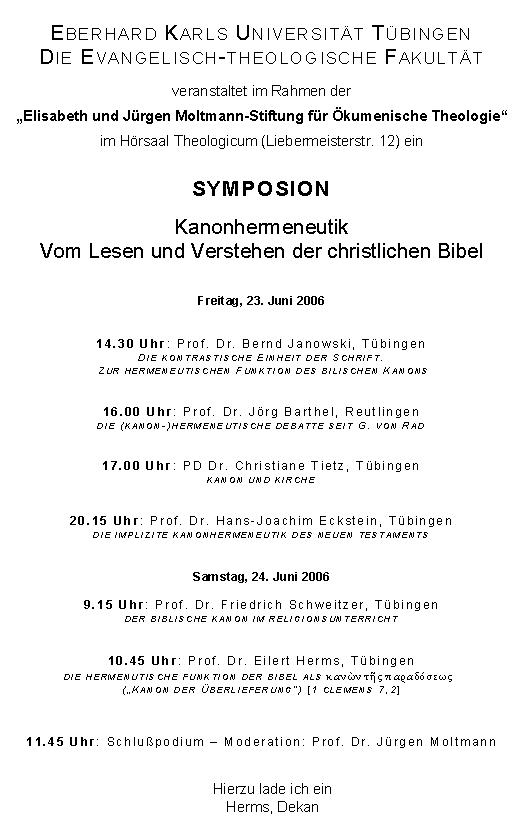
I will get around to responding to your comments, and posting my (of course, utterly devastating) friendly critique of Küng’s position on miracles. I’ve simply been enjoying the company of friends, and today – thanks to a tip from my dear friend, Volker – I shall be visiting a Symposium moderated by none other than Prof. Dr. Jürgen Moltmann. It promises to be a fascinating mini-conference, especially as the subject is one that personally interests me very much: The meaning and hermeneutical function of the biblical canon (Kanonhermeneutik. Vom Lesen und Verstehen der christlichen Bibel)

Here is some more information, if you really want to start salivating with jealousy ...

Until my Küng-rejoinder, I would point my readers to an excellent response to my initial post on Küng by Ben Myers, here (be sure to read the discussion on this one as well).

(Click to enlarge)

Labels: